Description
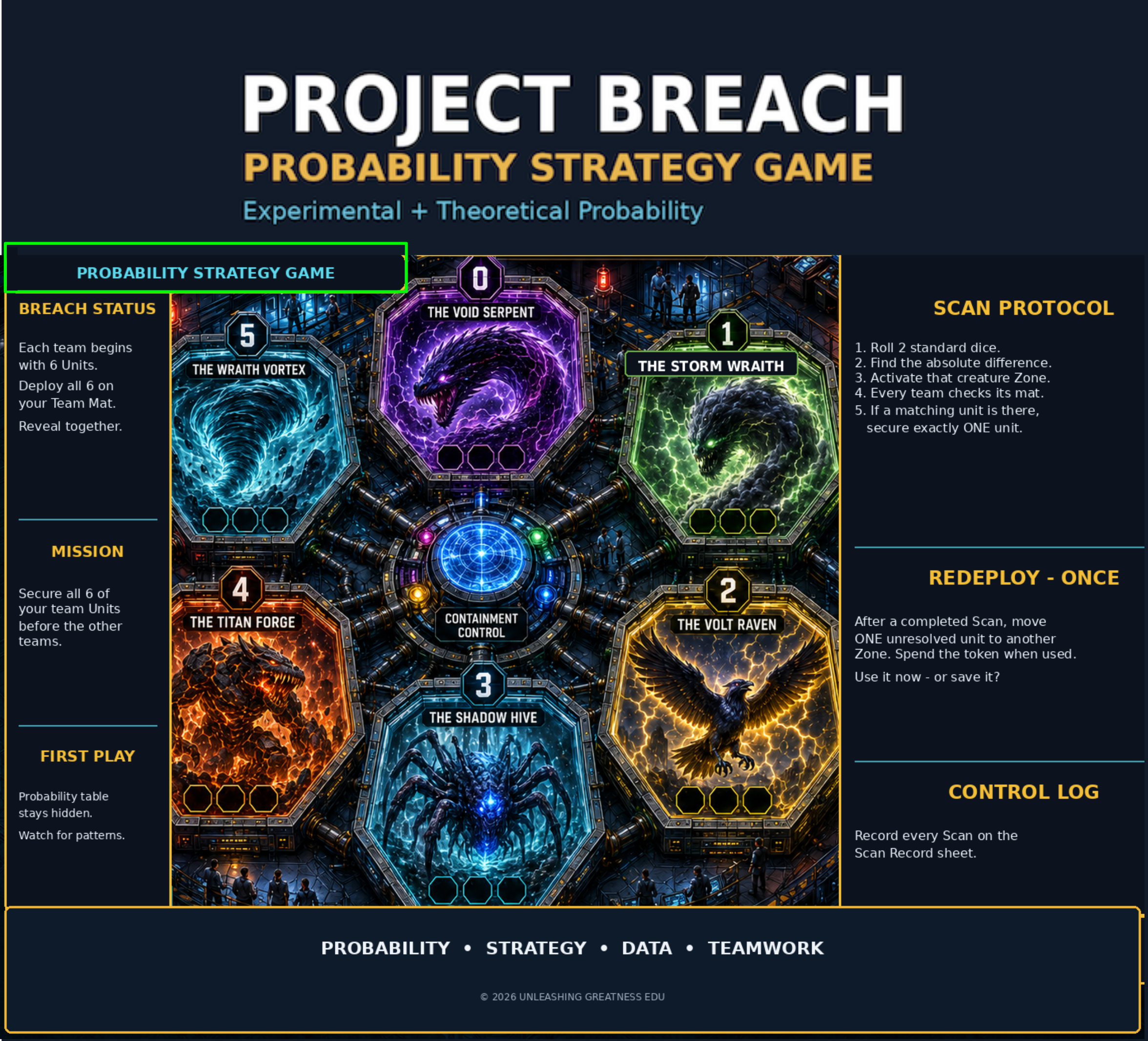
PROJECT BREACH turns probability into a strategic deployment challenge.
Students begin by deciding how to distribute limited resources across six zones. Shared dice rolls then determine what happens, forcing teams to evaluate their original choices, interpret emerging probability evidence, and decide whether a carefully timed redeployment could improve their position.
The result is a game in which probability affects strategy before, during, and after the dice are rolled.
DEPLOY • OBSERVE • ANALYZE • ADAPT
Students are not simply calculating probability in isolation. They must decide how mathematical information should influence their next move.
Students practice:
• interpreting probability and likelihood
• analyzing possible dice outcomes
• comparing expected and observed results
• using probability evidence to evaluate strategy
• allocating limited resources
• recognizing risk across different outcomes
• adjusting decisions as new evidence appears
• explaining and defending mathematical choices
Probability Becomes Strategy
PROJECT BREACH creates a natural connection between theoretical probability, experimental results, and strategic decision-making.
Students can compare what mathematics suggests should happen with what actually occurs during play—and then consider whether that evidence should change their strategy.
Questions emerge naturally:
Where should resources be deployed?
Which outcomes are more or less likely?
What does the evidence from play suggest?
Is this the right moment to redeploy?
Probability becomes information students can act on.
Flexible Classroom Use
PROJECT BREACH works well for:
• probability instruction
• theoretical and experimental probability
• partner or team play
• small-group instruction
• math centers and stations
• review and reinforcement
• enrichment
• collaborative mathematical discussion
The mathematics does not sit beside the strategy.
THE MATHEMATICS IS THE STRATEGY.